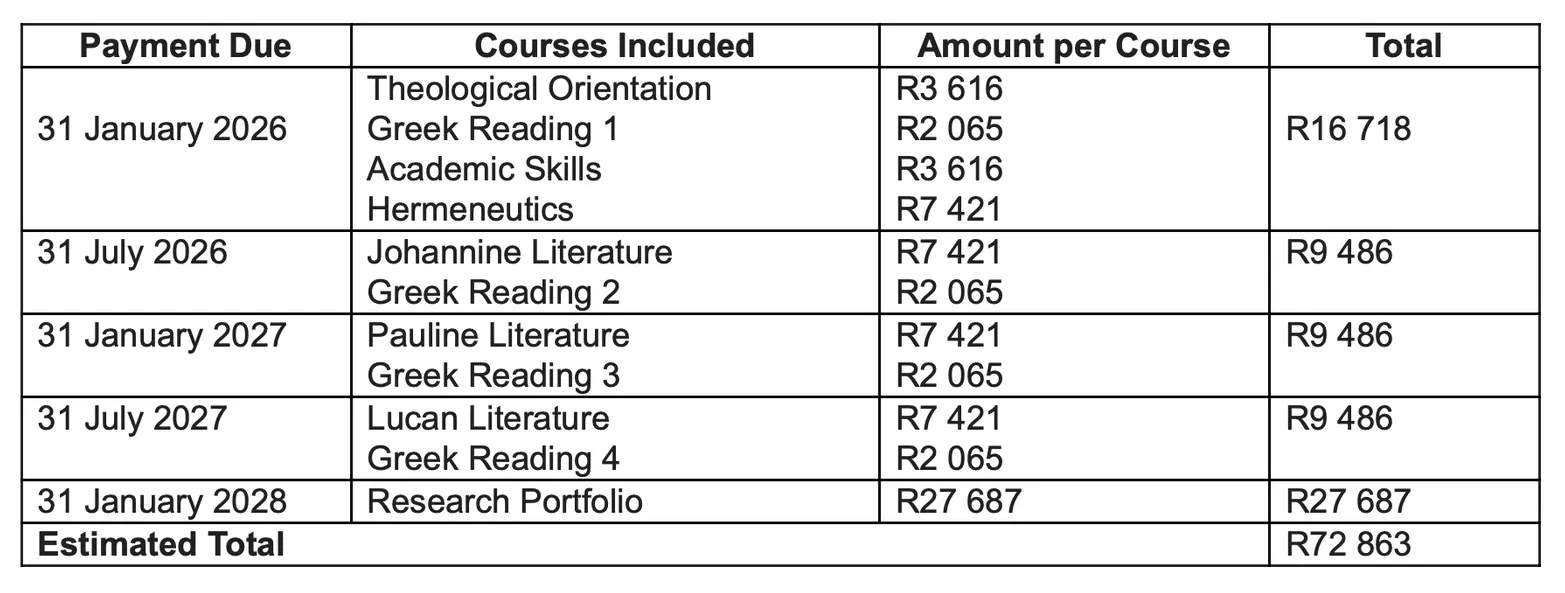
SATS is pleased to introduce the MTh Coursework. The first specialisation we introduced, starting on 1 February 2026, focuses on the New Testament. Additional specialisations will be launched in subsequent semesters.
Is the programme for me?
If you are interested in completing a master’s with a specialisation in New Testament, this programme is for you. The MTh Coursework (NT) is a structured research programme, meaning that students complete a selection of courses combined with a research project. Our objective is to produce graduates who are masters of the Greek New Testament, handling it from a contextual and Christocentric perspective with high-level excellence. We also aim to produce people who have mastered the core skills of communicating the message of New Testament texts to specialist and non-specialist audiences, in both writing and speaking.
How it works
The MTh Coursework (NT) is a 2½-year programme in which you will collectively learn as a cohort. You will, therefore, not study at your own pace. Intake for this programme will only be every two years, with the next intake being February 2028.
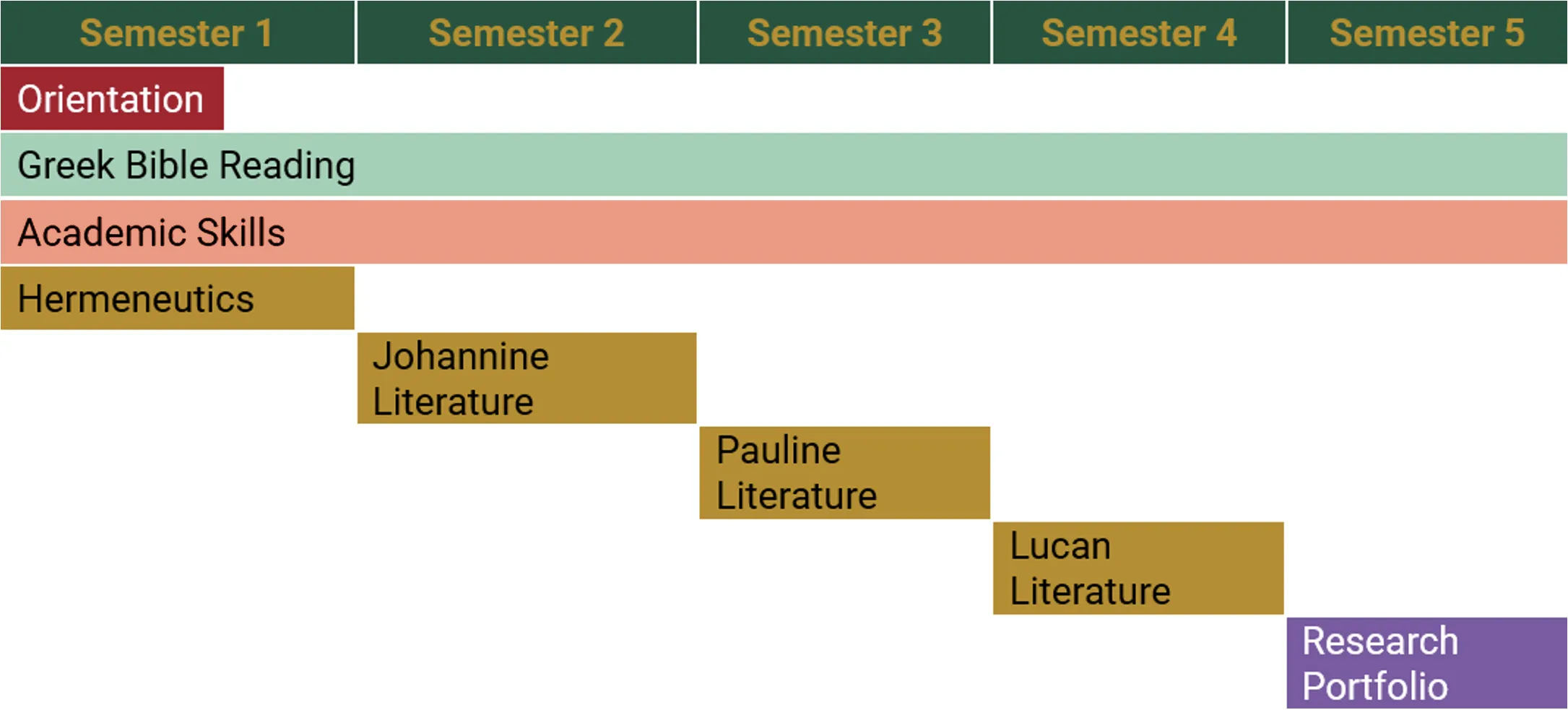
The first two years will consist of coursework, which covers academic skills, Greek Bible reading, and specialisation in four New Testament corpi. In the final six months, you complete a research portfolio and take the final assessments.
How does the MTh Coursework differ from SATS’s other Master’s programmes?
SATS has two other master’s programmes on NQF level 9. Our research-based MTh contains no credit-bearing coursework and culminates in a full thesis. The research journey is individualised and predominantly lies between supervisor and student. The Master of Divinity (MDiv) is tailored for professionals credentialed in other fields who are seeking advanced training for ministry. It consists of 180 credits of coursework across the theological discipline with a 60-credit capstone research project.
In the MTh Coursework, your research journey is plotted along a predetermined selection of courses and culminates in a research project or a portfolio of evidence. As with the research MTh, you specialise in a specific field or sub-discipline (New Testament), but the research process is completed simultaneously by a cohort of students.
What will the curriculum look like?
The programme consists of 180 credits, divided into core skills, specialisation courses, and a research portfolio. We require our MTh Coursework graduates to cultivate fluency in reading and translating the Greek New Testament. Therefore, a Greek reading programme runs through the programme. You will read large portions of the Greek New Testament. By the end of the programme, you need to demonstrate the ability to read the GNT proficiently.
The bulk of the programme is built around the study of passages of Scripture, seeking to build holistic or integrated exegetical competence. The passages are clustered into four themes: (a) Hermeneutics and Exegesis, (b) Johannine Literature, (c) Pauline Literature, and (d) Lucan Literature. The layout of the curriculum can be seen below:
Core (48 credits)
Specialisation (72 credits)
Hermeneutics (18 credits)
Johannine Literature (18 credits)
Pauline Literature (18 credits)
Lucan Literature (18 credits)
Research (60)
The timeline below will give you an idea of what the programme will look like: